GCM Kids
Why should a child's
first sport be tennis?
Why the world's elite choose tennis as their child's first sport — organized not as rumor, but with academic and medical evidence.
The Evidence
From focus to growth, mental strength, social skills and lifelong health — changes backed by evidence.
Frontal Lobe & Cerebellum, Activated at Once
Sharper focus for learning
Tennis requires predicting the ball's spin, speed and landing point within 0.1 seconds. This simultaneously activates the frontal lobe (focus and cognition) and the cerebellum (sensory integration), dramatically raising the immersion and problem-solving ability needed for study.
Evidence · Harvard Medical School research · Frontiers in Human Neuroscience
Growth-Plate Stimulation & Full-Body Core
Balanced physical development
Explosive sprints and deceleration give appropriate stimulation to the lower-body joints and growth plates, promoting growth. The rotational swing develops the core muscles around the spine in balance.
Evidence · Korean Society of Sports Medicine · youth development research
Resilience & a High Mental Index
Self-efficacy & crisis management
During a match, players must adjust strategy and control emotions on their own, without outside help. Shaking off mistakes and preparing for the next point raises a child's self-efficacy and crisis-management ability.
Evidence · Association for Applied Sport Psychology (AASP)
Lifelong Social Skills & Manners
Consideration & empathy
Children who play racket sports show higher consideration and empathy for others. Through refined rules that respect the opponent across the net, they gain the manners and grace that are welcomed anywhere.
Evidence · British Journal of Sports Medicine (BJSM) longitudinal study
Long-Term Health & Longevity
A lifelong physical & mental asset
Among many sports, tennis players showed the longest life expectancy (about 9.7 years longer on average). Tennis learned in childhood becomes a lifelong physical and mental asset.
Evidence · Copenhagen City Heart Study
VIP Offer
GCM KIDS VIP Special Offer
Apply for a ‘VIP trial lesson’ by DM right now. Our dedicated coaches provide close 1:1 consultation tailored to your child's disposition and physique.
Kids Class
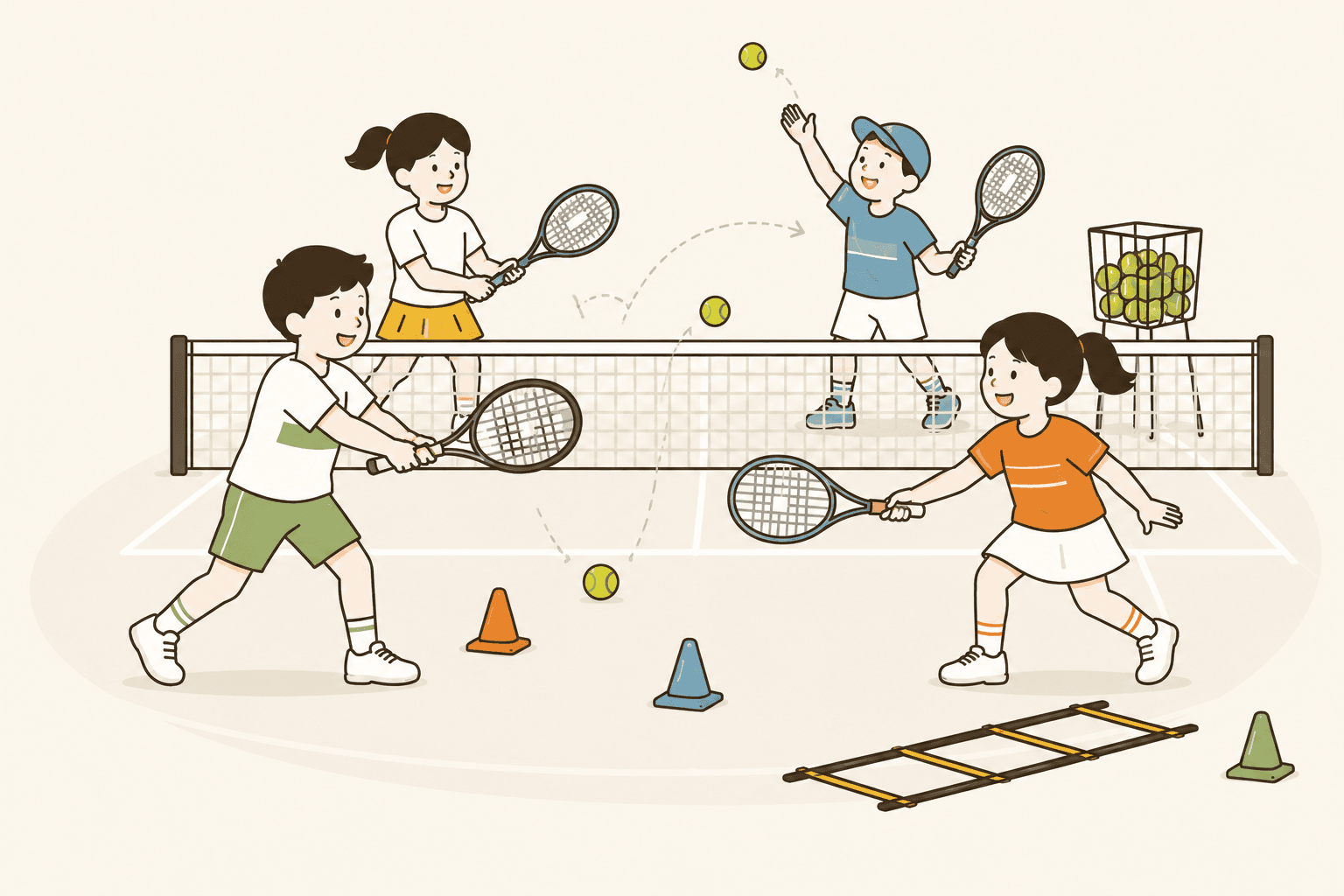
First tennis learned like play — athleticism, court adaptation and fundamentals, joyfully.
- ·Small group coaching by age
- ·Fundamentals · footwork · coordination
- ·Fun-centered motivation
The AI-Era Talent
The aura of the top 1% leader
that AI cannot replace
In the AI era, prized talent is shifting from 'finding the answer (Knowledge)' to 'reading context and judging for oneself (Meta)'. Tennis builds both soft skills and real-time meta-cognition at once — the finest early platform for character and leadership.
Honesty without a referee (self-call) · resilience to endure 1:1 solitude
Moving 3D chess (space & trajectory) · decisive judgment executed in 0.1s
Core Competencies
Self-reliance, resilience, integrity and strategic thinking — perfectly aligned with the talent the future demands.
Self-Reliance & Problem-Solving
A quintessential 'solo sport' where, once play begins, outside help is banned. In a split-second rally you must read the ball's path, the opponent's position and even the wind, and decide your best shot alone.
Choosing alone on court and owning the result → grows into a person who defines problems and delivers solutions on their own.
Resilience & Mental Management
Tennis is a 'sport of errors'. Even pros miss constantly, and dwelling on one lost point costs the next. Shaking off self-blame and focusing on the 'next ball' is essential mental training.
The agility to accept failure and pivot to the next step rather than despair → a core criterion for talent in a fast-changing world.
Integrity · Manners · Fair Play
With no umpire, players call the lines themselves ('self-call'). Resisting the temptation to cheat, they judge honestly, shake hands afterward and learn to accept the result.
Embodying moral autonomy and honesty — following rules and respecting opponents → grows into a leader others trust.
Integrated Brain Development & Agility
'Chess played with the body'. A complex brain workout that fires the visual cortex, motor cortex and prefrontal lobe at once — predicting the opponent's move and switching strategy in under half a second dramatically develops neural networks.
Reading real-time data fast and showing strategic vision and quickness → a hallmark of the top 1%. Neuroplasticity translates directly into academic and business strategy.
Unrivaled
Compared with soccer, swimming, golf and basketball — the unique, unrivaled value of tennis.
'Relative Fairness' vs. Soccer & Basketball
Basketball rewards height, soccer size and speed. Tennis is one of the few sports where a smaller player can overwhelm a bigger one through timing, strategy, spin and mentality.
'Lifelong Feel + Explosive Workout' vs. Golf
Golf burns little; soccer and basketball fade with age and injury. Tennis is an hour of chess (mind) and marathon (cardio) at once, and the swing and footwork learned young become a 'lifelong legacy' enjoyed past 80.
'100% Ownership' vs. Team Sports
In team sports mistakes get buried and you can lose because of teammates — breeding blame and resentment. In tennis you're alone on court, so every point, win or loss is fully yours — growing a mature adult who owns the outcome 100%.
'Global Etiquette' vs. Every Sport
Most sports lean on referees or hard physical contact. Tennis is the one sport where sportsmanship itself is written into the rules — feeding the ball considerately, applauding good shots, and calling lines honestly.
Symbolic Capital
Tennis learned young is the finest 'symbolic capital' and 'human asset' for entering upper-society and business circles naturally.
Peak Mental & Physical Recharge
For CEOs making complex decisions, tennis offers top-tier flow — firing up the brain while making work stress vanish completely.
Time-Efficient, High-Intensity Networking
Where golf takes 6–8 hours, tennis delivers an explosive workout, full immersion and dense exchange in 1–2 — the best ROI for busy leaders.
Networking Built on Manners & Class
A gentleman's sport built on trust (self-call). Character and business etiquette show in on-court manners and crisis response — the successful use tennis to pick who they'll work with.
Mindset
Enduring solitude on court and overcoming momentary crises with strategy becomes an immense mental asset in life's bigger crises.
A typical child
Fails a test → "I'm done, studying won't help" → long-term frustration and drift
A child who learned tennis
Fails a test → "I just lost this one point" → analyze the cause → prepare for the next
Read the whole court's flow → read the opponent's position and tempo → focus only on your best possible shot
The composure to read the Flow leads to pacing in life. The maturity to accept wins and losses (Acceptance), and deep mutual respect.